Discovery drives demand. Learn why the best reservation platform helps travelers find your winery before it ever asks them to book.
For years, wineries have evaluated reservation software based on operational features:
Those capabilities are important—but they all begin after a visitor has already decided to visit your winery.
The real question every winery should ask is:
How did that visitor discover us in the first place?
In today's competitive wine industry, discovery has become just as important as the reservation itself.
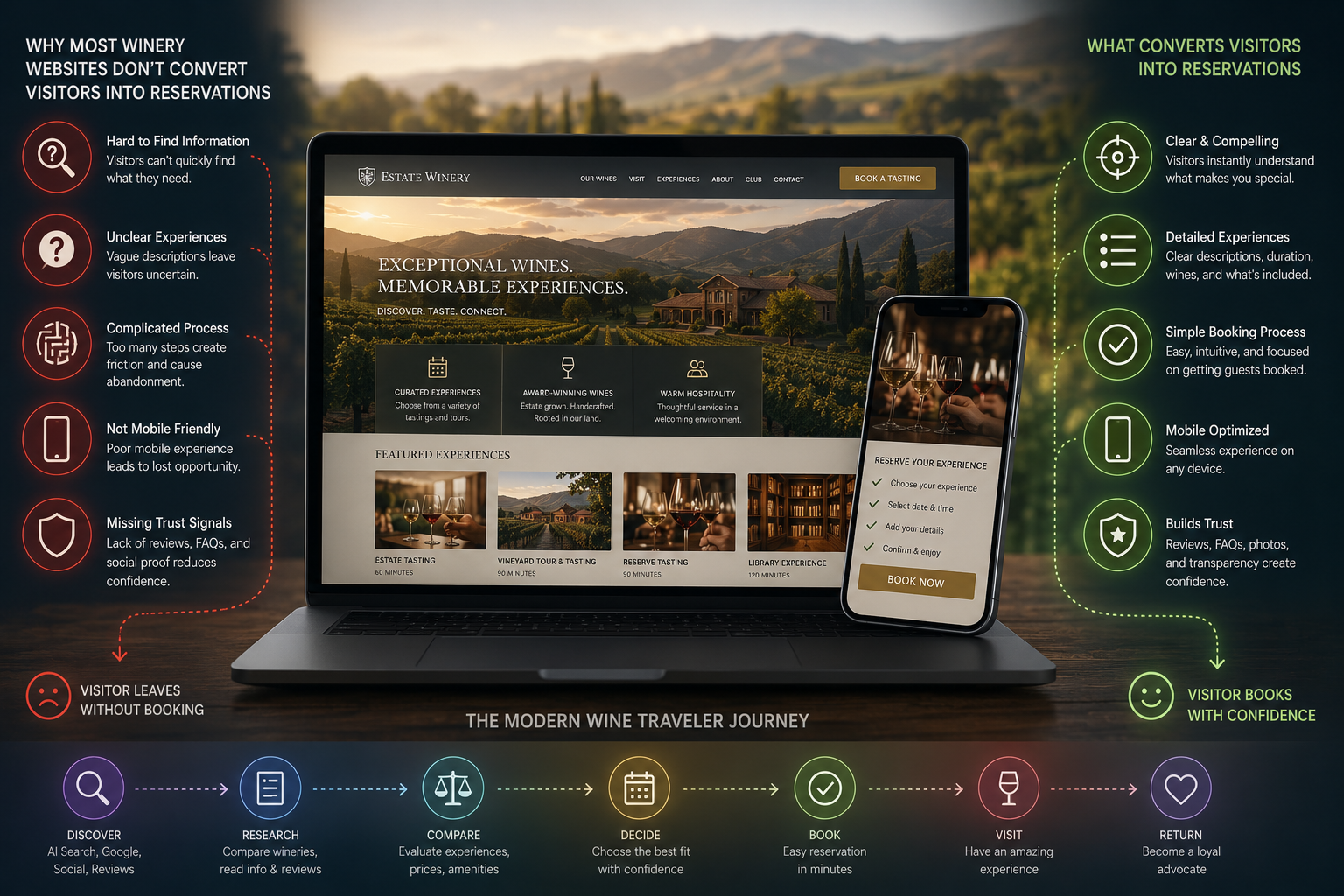
Before someone books a tasting, they typically go through a journey that looks like this:
Dream → Research → Compare → Decide → Reserve → Visit
Many reservation systems only participate in one step of that journey:
Reserve.
By the time a guest reaches your reservation page, they've often already narrowed their choices based on dozens of other factors.
That means the biggest opportunity isn't making reservations easier—it's helping more qualified visitors discover your winery before they choose somewhere else.
A decade ago, visitors often started with Google.
Today they may begin with:
Increasingly, consumers ask AI questions like:
"What are the best family-friendly wineries in Napa Valley?"
or
"Recommend wineries with cave tours near Yountville."
If your winery isn't represented where travelers are researching, your reservation system never gets the opportunity to do its job.
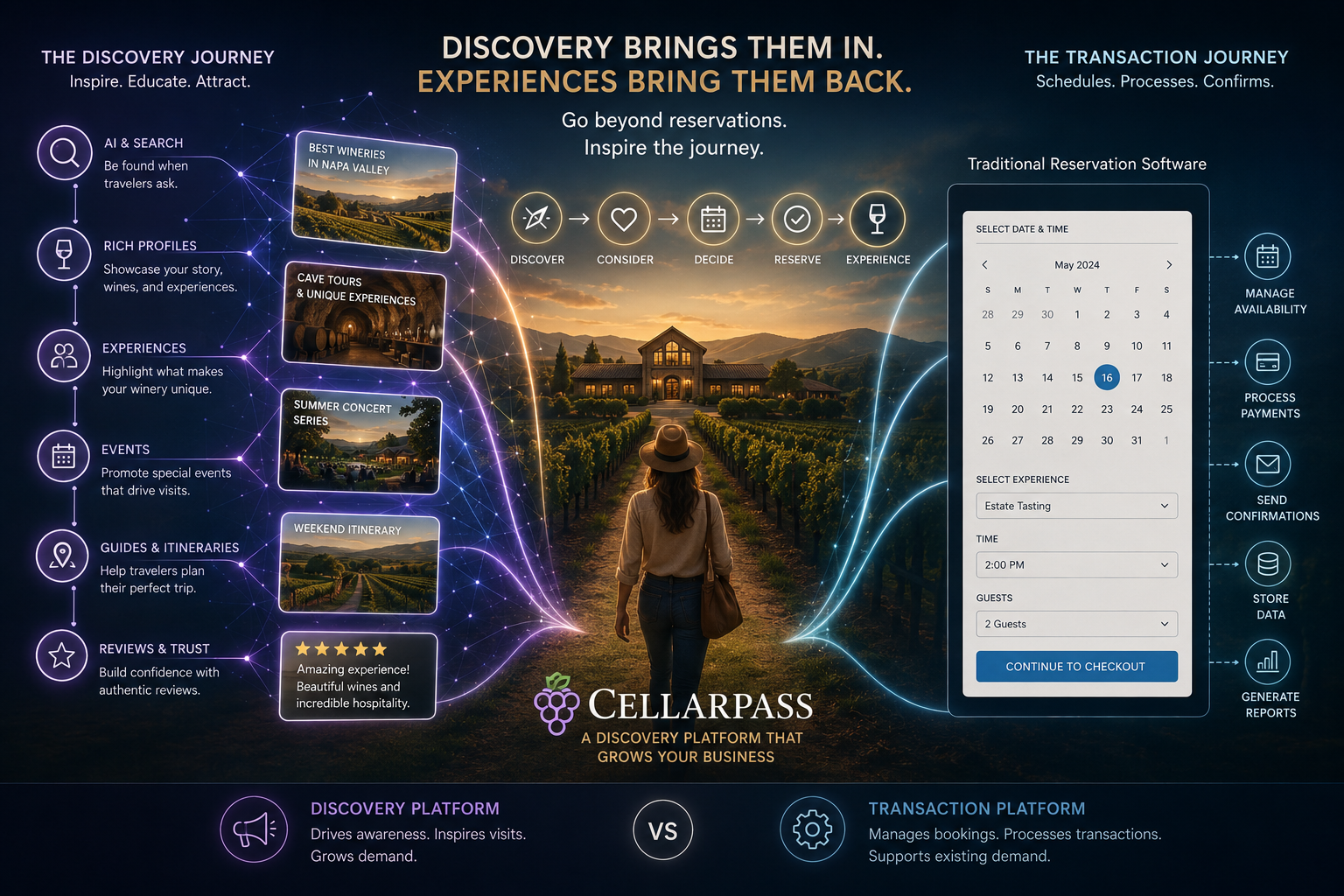
Traditional reservation software is designed primarily to manage demand that already exists.
Its strengths typically include:
These are essential operational capabilities.
However, they generally assume the customer has already chosen your winery.
They don't actively create demand.
A discovery platform works much earlier in the customer journey.
Its purpose is to inspire travel, educate visitors, and help consumers decide where they want to spend their time.
That means helping travelers answer questions such as:
The easier it is for consumers to answer those questions, the easier it becomes for them to make a reservation.
Not all website traffic is equal.
A visitor who lands on your reservation page without understanding your winery may abandon the booking.
A visitor who has already explored:
arrives with confidence.
Discovery creates more informed guests, and informed guests are more likely to convert.
Consumers don't wake up wanting a reservation at 2:30 PM.
They want memorable experiences.
They search for:
A discovery-focused platform highlights those experiences long before visitors ever see a booking calendar.
That changes the conversation from:
"Pick a reservation time."
to
"Choose the experience that's right for you."
Special events aren't just additional revenue opportunities.
They're powerful marketing tools.
Events create reasons for consumers to:
When events are actively promoted to consumers who are looking for things to do, they become part of your customer acquisition strategy—not simply another reservation type.
Modern travelers expect far more than a winery name and address.
They want to understand:
The more complete your business profile, the easier it becomes for travelers—and AI assistants—to recommend your winery.
Consumers increasingly ask conversational questions instead of searching for keywords.
Examples include:
These recommendations are based on context—not simply reservation availability.
Businesses with richer content and stronger digital profiles are more likely to be surfaced in AI-generated recommendations.
The relationship shouldn't stop once a reservation is booked.
Great discovery platforms continue helping visitors by recommending:
Helping travelers build a better itinerary creates a better overall experience—and strengthens the destination as a whole.
Both types of platforms play an important role, but they solve different problems.
Transaction PlatformDiscovery PlatformProcesses reservationsInspires visits before bookingFocuses on operationsFocuses on traveler acquisitionManages availabilityPromotes experiences and eventsRecords customer transactionsHelps consumers compare and exploreSupports existing demandHelps generate new demandOptimizes the booking processOptimizes the entire traveler journey
For wineries evaluating technology, it's worth considering not only how reservations are managed, but also how new visitors are attracted in the first place.
CellarPass was designed with a broader vision than reservation management alone.
In addition to providing reservation capabilities, CellarPass actively helps wineries connect with wine consumers through:
Rather than waiting for consumers to arrive at your website, CellarPass helps place your winery where travelers are actively planning their next wine country adventure.
Managing reservations is an important part of running a successful winery—but reservations are only one chapter of the guest journey.
The wineries that will thrive in the years ahead are those that invest not only in efficient operations, but also in being discovered.
As AI-powered search, destination planning, and experience-based travel continue to reshape consumer behavior, wineries should look beyond reservation management alone and ask a more strategic question:
Is our technology simply processing reservations, or is it helping travelers discover us in the first place?
At CellarPass, we believe the future belongs to wineries that excel at both.