Your next customer may already be planning a wine country getaway. The question is whether they'll discover your winery before making
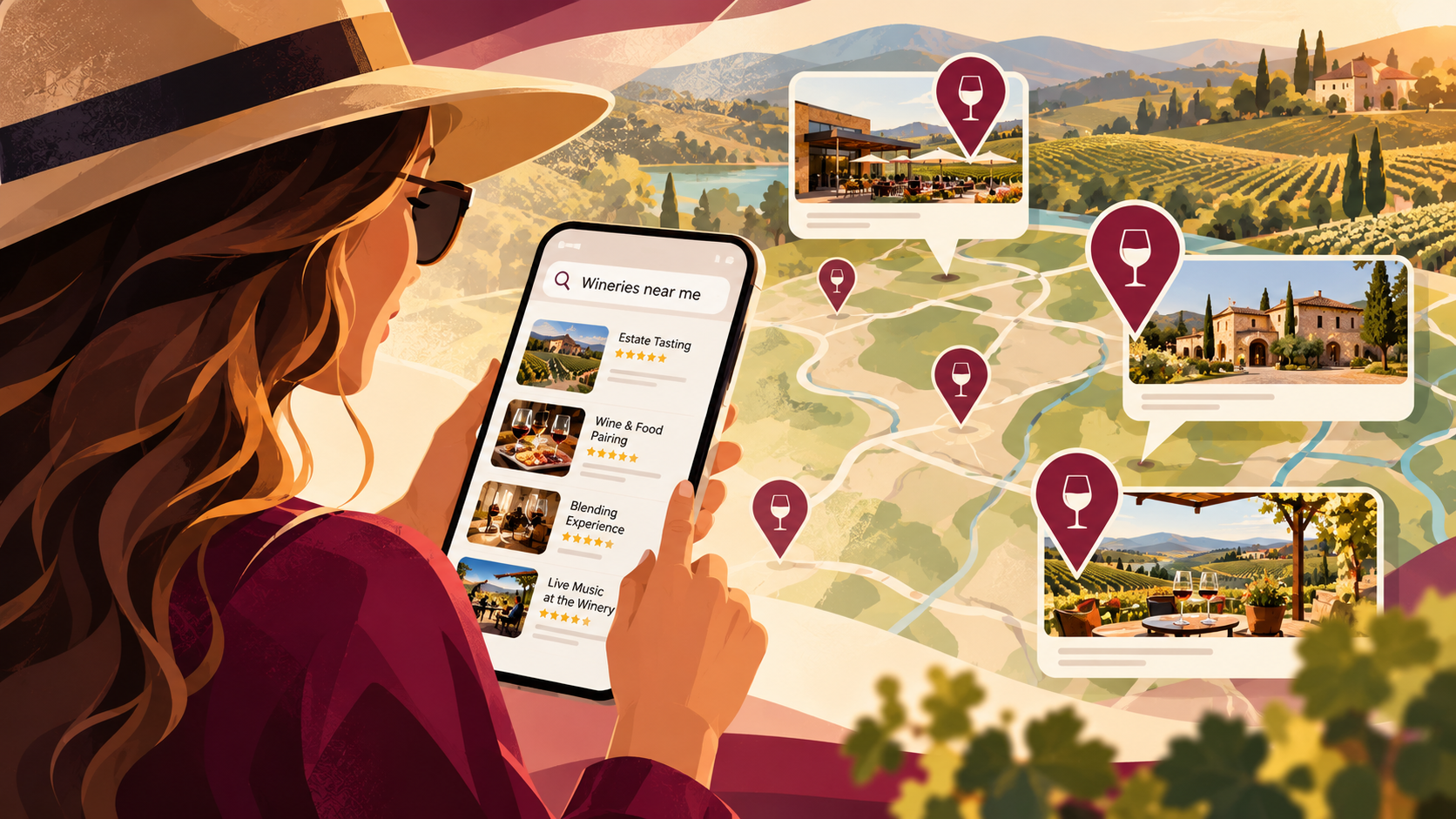
For years, wineries have invested heavily in creating exceptional tasting room experiences. Beautiful architecture, knowledgeable hospitality teams, curated wine flights, and breathtaking vineyard views have all become part of the modern wine country experience.
But there's a fundamental problem with even the most impressive tasting room.
It can't attract visitors who don't know it exists.
As wineries navigate softer visitation, increased competition, and changing consumer behavior, there's a tendency to focus on declining tasting room traffic as the primary challenge.
And while regional tourism trends certainly matter, some wineries may be overlooking an equally important issue: consumers are actively searching for experiences, but those searches aren't necessarily leading them to your winery.
The opportunity isn't simply convincing more people to travel to wine country.
It's ensuring that when consumers are planning a visit, looking for something memorable to do, or exploring wineries they've never heard of, your winery is part of the conversation.
Think about how someone plans a weekend in Napa Valley, Sonoma County, or another wine region.
They may begin with a Google search for the best wineries to visit, ask an AI assistant to recommend experiences, browse social media for ideas, or explore a destination website featuring local attractions.
Perhaps they're celebrating an anniversary, organizing a birthday weekend, or simply looking for a memorable afternoon with friends.
At this stage, they probably aren't searching for your winery by name.
They're searching for an experience.
That distinction is important.
A consumer searching for "wine and food pairings in Sonoma" has already expressed interest in something your winery might offer. But if your experience isn't appearing where that consumer is looking, you may never have an opportunity to earn the reservation.
Your website might be beautifully designed. Your hospitality team might be exceptional. Your wines might consistently receive outstanding reviews.
None of those strengths matter if the consumer never discovers you.
A great winery website helps convert interest into reservations. But it shouldn't be the only place consumers can discover what you offer.
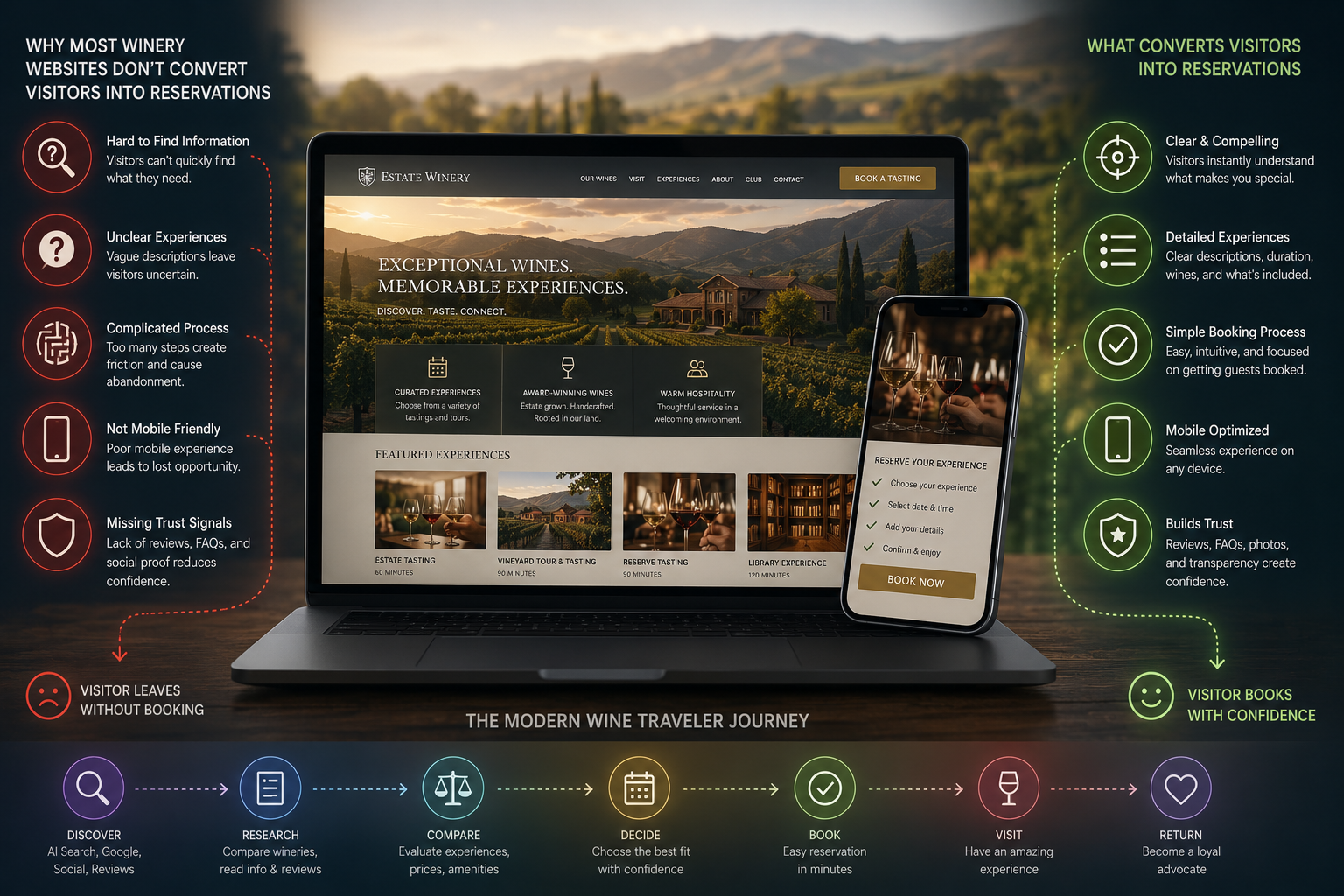
Understanding how consumers make decisions is essential to building a more effective digital hospitality strategy.
Too often, wineries treat these three stages as a single process. In reality, each presents different opportunities to influence a potential guest.
Discovery happens when someone first becomes aware of your winery or one of its experiences.
They might find you through a search engine, a travel article, a social media post, a hotel recommendation, or a winery experience marketplace.
At this stage, the consumer may have no familiarity with your brand.
They're evaluating possibilities and looking for activities that match their interests, schedule, location, and budget.
The winery's objective is straightforward: become visible to people who are already looking for experiences you provide.
This requires more than optimizing your website for your winery's name.
It means making your experiences discoverable through relevant searches, destination guides, third-party platforms, and referral partners.
Once someone discovers your winery, the next question is whether the experience is worth booking.
They'll evaluate what makes your offering special, how much it costs, how long it takes, whether it's appropriate for their group, and how it compares with other options.
This is where presentation becomes critical.
A listing that simply says "Reserve Tasting — $65" offers very little context.
Compare that with an invitation to enjoy a guided estate tasting featuring five limited-production wines, a stroll through the vineyard, and views overlooking the valley.
The second description gives consumers a better understanding of what they're purchasing.
High-quality photography, transparent pricing, clear descriptions, guest reviews, and straightforward availability information all help consumers make confident decisions.
You're no longer just competing on wine quality.
You're competing on the perceived value of the entire experience.
A consumer has discovered your winery, explored the offerings, and decided they want to visit.
Now comes the final challenge: completing the reservation.
An outdated booking interface, confusing availability calendar, unexpected fees, or a reservation process that's difficult to navigate on a smartphone can introduce unnecessary friction.
The fewer obstacles between a guest's decision and a confirmed reservation, the better.
The objective should be a seamless progression from discovering an experience to completing a booking.
Because generating consumer interest is only valuable when that interest has a clear path toward becoming a reservation.
Many wineries invest considerable resources into their websites, digital advertising, and email marketing.
These are valuable investments, particularly when communicating with people who already know the brand.
But they have an inherent limitation.
A winery's own website is often most effective when consumers already know what they're searching for.
Someone who has never heard of your winery is unlikely to type your name into a search engine.
They may, however, search for "romantic winery experiences," "wine blending classes," "wineries with live music," or "wine tasting near Healdsburg."
These searches represent opportunities to introduce your winery to entirely new audiences.
The solution isn't abandoning your website or existing marketing channels.
It's expanding the number of places where consumers can encounter your experiences.
Think about how hotels approach customer acquisition. They maintain their own websites and encourage direct reservations, but many also participate in travel marketplaces where potential guests compare destinations and properties.
Wineries can benefit from a similar approach.
Your website remains the home of your brand story, but consumer discovery shouldn't depend entirely on visitors finding that website first.
One of the limitations of traditional winery marketing is its reliance on existing customer relationships.
Email campaigns promote events to wine club members. Social media posts reach existing followers. Invitations are distributed to previous guests.
These activities are important for retention and repeat visitation.
But they don't necessarily introduce the winery to a meaningful number of new customers.
If your marketing efforts primarily reach people already familiar with your brand, your customer acquisition opportunities may be limited.
Consider a winery hosting a seasonal wine and culinary event.
An email campaign to existing customers might generate immediate reservations.
But what about visitors arriving in wine country that weekend? What about hotel guests looking for an evening experience? Or local residents searching for something different to do?
These consumers may be interested in the event but have no connection to the winery's existing communication channels.
Reaching them requires a broader approach to discovery.
The question isn't simply how many people received your latest email.
It's how many potential customers could discover your experience who had never heard of your winery before.
There's another important opportunity wineries frequently overlook.
Consumers don't always choose a winery first and then decide what to do when they arrive.
Increasingly, an experience itself can be the attraction.
Someone may not be searching for a particular winery, but they could be looking for a blending workshop, a wine and cheese pairing, a winemaker dinner, or a relaxed afternoon with live music.
These interests provide additional opportunities for discovery.
A winery offering five distinct hospitality experiences effectively has five different ways to appeal to potential visitors.
But only if those experiences are presented and promoted individually.
Instead of treating your entire hospitality program as one generic "Wine Tasting" offering, consider giving each experience its own descriptive title, imagery, detailed explanation, and bookable listing.
This can make your offerings more relevant to specific consumer interests and create additional opportunities to appear in search results and experience discovery platforms.
The goal is to market what makes each experience memorable, not simply the fact that your winery is open for tastings.
Consumers routinely use third-party platforms to discover restaurants, hotels, attractions, and activities.
Wine country experiences are no exception.
Destination guides, hotel concierges, regional tourism websites, social platforms, search engines, and specialized wine experience marketplaces can all play roles in introducing consumers to wineries.
Each channel reaches people at different points in the planning process.
Some are researching destinations months in advance. Others are already in wine country looking for something to do tomorrow.
Wineries should evaluate where their target audiences are actively searching and ensure their offerings can be found in those environments.
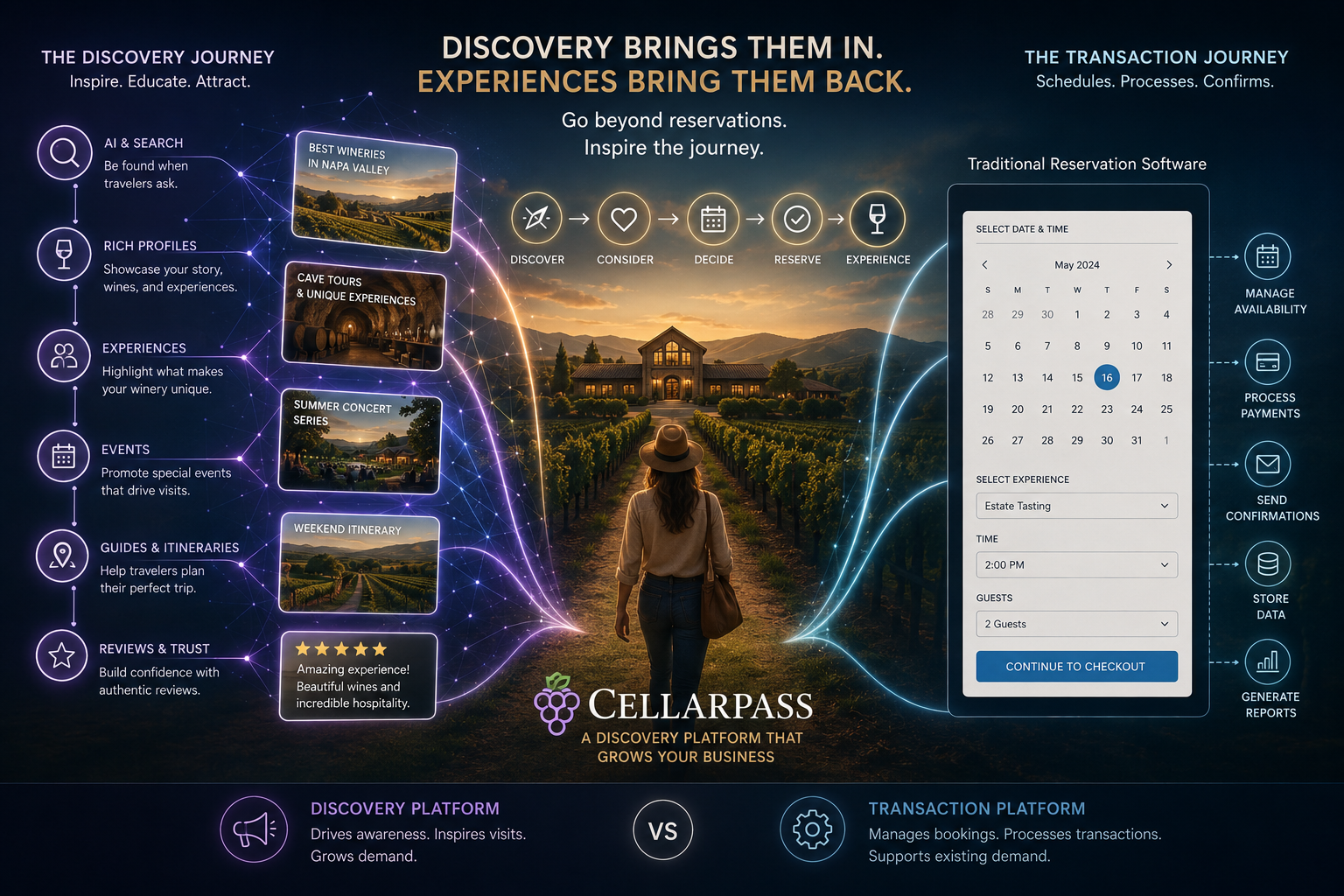
Platforms such as CellarPass provide opportunities for wineries to present bookable tastings and events to consumers exploring wine country experiences.
Rather than relying exclusively on people visiting a winery's website, participating in a consumer-facing discovery platform can provide another potential path from consumer interest to a confirmed reservation.
That distinction matters.
A reservation system helps manage demand.
A discovery strategy helps create opportunities for new demand.
And in today's competitive hospitality environment, wineries need to think about both.
The ways consumers research travel and leisure activities continue to evolve.
Alongside traditional search engines, consumers can now ask AI-powered assistants for recommendations based on specific preferences.
A traveler might ask for boutique wineries near Sonoma offering seated food pairings, or request recommendations for unique experiences suitable for a weekend getaway.
This introduces another reason to make hospitality offerings clear, descriptive, consistent, and accessible online.
Wineries should ensure their public information accurately describes their location, available experiences, policies, and other details that help consumers evaluate whether a visit is appropriate.
Search engine optimization remains important, but wineries should also pay attention to how their businesses are represented across trusted third-party websites and destination resources.
No platform can guarantee inclusion in an AI-generated recommendation, and these systems vary in how they discover and display business information.
Nevertheless, the broader principle remains the same.
Your winery needs a recognizable digital presence wherever consumers begin researching their next experience.
Improving discovery doesn't necessarily require an enormous advertising budget.
It begins with understanding how consumers search and ensuring your winery is represented where those searches happen.
1. Think like a visitor, not a winery owner.
Search for experiences in your region without using your winery's name. Look for terms such as "best wine tastings near me," "Sonoma wine experiences," or "Napa winery events this weekend." Examine which businesses, guides, and platforms appear and whether your winery is represented.
2. Give every signature experience its own identity.
Create compelling names, descriptions, and photography for your tastings, culinary programs, workshops, and special events. Clearly communicate what makes each experience distinctive.
3. Expand beyond your owned marketing channels.
Evaluate regional tourism websites, travel partners, hotel concierge programs, event listings, and consumer discovery platforms that can introduce your winery to audiences beyond your existing email list and social followers.
4. Make reservations simple and transparent.
Clearly display availability, prices, duration, group requirements, and cancellation policies. Ensure consumers can easily complete the reservation process on mobile devices.
5. Measure how guests actually discover you.
Track referral sources, booking conversions, first-time guest reservations, and the effectiveness of individual promotional channels. Use booking analytics and guest feedback to understand which efforts are generating new business.
These actions should work together, creating a more complete customer acquisition strategy rather than a collection of disconnected marketing activities.
Website traffic is a useful metric, but it rarely tells the whole story.
A winery might experience an increase in website visits without seeing a corresponding increase in reservations.
Alternatively, a third-party discovery channel might introduce qualified consumers who complete their bookings with relatively little additional research.
The more meaningful question is whether your digital presence is generating profitable new customer relationships.
Consider tracking the number of first-time guests, confirmed reservations by source, booking conversion rates, revenue per reservation, and repeat visits.
For third-party platforms, evaluate acquisition costs and fees alongside the incremental reservations and customer relationships they generate.
It's also worth distinguishing between consumers who would have booked directly anyway and customers a channel genuinely helped you acquire.
Better visibility matters, but visibility without conversion or economic value is not a complete success.
The wine industry has spent decades perfecting the tasting room experience.
From intimate family estates to spectacular architectural destinations, wineries have created some of the most memorable hospitality environments in the country.
But the competitive landscape has changed.
Consumers have more choices, more ways to research activities, and more opportunities competing for their leisure time.
A beautiful winery, exceptional hospitality, and award-winning wines aren't always enough to bring new guests through the door.
Wineries need to become more intentional about how new customers find them.
That means looking beyond traditional marketing campaigns, expanding their presence across relevant consumer discovery channels, and ensuring every compelling experience has a clear path to reservation.
It also means recognizing that a winery website, no matter how beautifully designed, is only one part of the consumer's decision-making journey.
Your next customer may already be searching for exactly the experience you offer.
The question is whether your winery will appear when they're looking.
And perhaps that's the most important marketing question wineries should be asking as they plan for 2027.
Not simply, "How do we get more people to visit?"
But "How do we make sure more people discover us in the first place?"
Industry references: Silicon Valley Bank's 2026 Direct-to-Consumer Wine Report and WISE's 2026 Tasting Room Benchmark Report. The article's recommendations are editorial analysis rather than claims that any particular discovery platform guarantees increased bookings.