Discover how SEO, AEO, and GEO help wineries improve visibility, earn AI recommendations, and attract more qualified visitors.

Your website is no longer just competing for Google rankings—it's competing to become the answer that AI recommends.
For nearly two decades, Search Engine Optimization (SEO) has been the foundation of digital marketing. Winery websites focused on ranking for keywords like Napa Valley Cabernet tasting, Paso Robles wineries, or wine tasting near me.
Today, the search landscape has fundamentally changed.
Consumers are increasingly using ChatGPT, Google AI Overviews, Gemini, Claude, Perplexity, Microsoft Copilot, and other AI assistants to plan trips, compare wineries, discover restaurants, and make purchasing decisions.
Instead of browsing through ten blue links, they're asking questions like:
The answer they receive may never require them to visit a traditional search results page.
That's why every winery, brewery, restaurant, hotel, and tourism business needs to understand three complementary strategies:
Together, they determine whether your business is found—or forgotten.
Search Engine Optimization helps your website rank within traditional search engines.
Its goal is straightforward:
Help search engines understand what your business offers so they can confidently recommend your pages.
Good SEO includes:
SEO remains incredibly important because AI systems often rely on well-ranked, trustworthy websites when generating responses.
If Google doesn't trust your website, AI likely won't either.
Answer Engine Optimization is about making your content easy for AI systems to extract and quote.
Traditional SEO asks:
"How do I rank?"
AEO asks:
"How do I become the answer?"
For example:
Instead of writing:
"Our winery offers exceptional experiences."
AEO content explains:
The more directly you answer visitor questions, the easier AI can reference your content.
Think of your website as building the world's best FAQ—even if those answers appear naturally throughout your pages.
Examples include:
These answers help both humans and AI.
Generative Engine Optimization (GEO) is the newest discipline.
Rather than optimizing for search rankings, GEO optimizes for AI-generated recommendations.
When someone asks ChatGPT:
"Recommend wineries similar to Far Niente."
The AI isn't looking for keywords.
It's looking for context.
It wants to understand:
The richer your content, the more likely AI can confidently recommend your business.
AI systems don't browse websites the way people do.
They analyze information.
They connect relationships.
They compare businesses.
They summarize experiences.
They identify expertise.
This means your website should communicate more than marketing language.
Instead of saying:
"Experience unforgettable wines."
Explain:
Specificity wins.
Many winery websites still focus almost entirely on beautiful photography.
Photography matters.
But AI cannot fully understand a beautiful vineyard image without accompanying context.
The most effective websites include detailed information about:
AI loves context.
Generative AI frequently incorporates signals from review platforms.
It's not simply the rating.
It also evaluates:
Hundreds of guests independently describing your winery as:
becomes incredibly valuable.
Encourage authentic reviews after every visit.
Schema markup tells search engines exactly what your content represents.
Instead of guessing, AI understands:
Structured data improves both traditional SEO and AI visibility.
AI prefers current, accurate information.
Businesses that continually publish new content often demonstrate stronger expertise.
Examples include:
Every new article becomes another opportunity to answer customer questions.
One of the biggest mistakes businesses make is assuming visitors only care about booking.
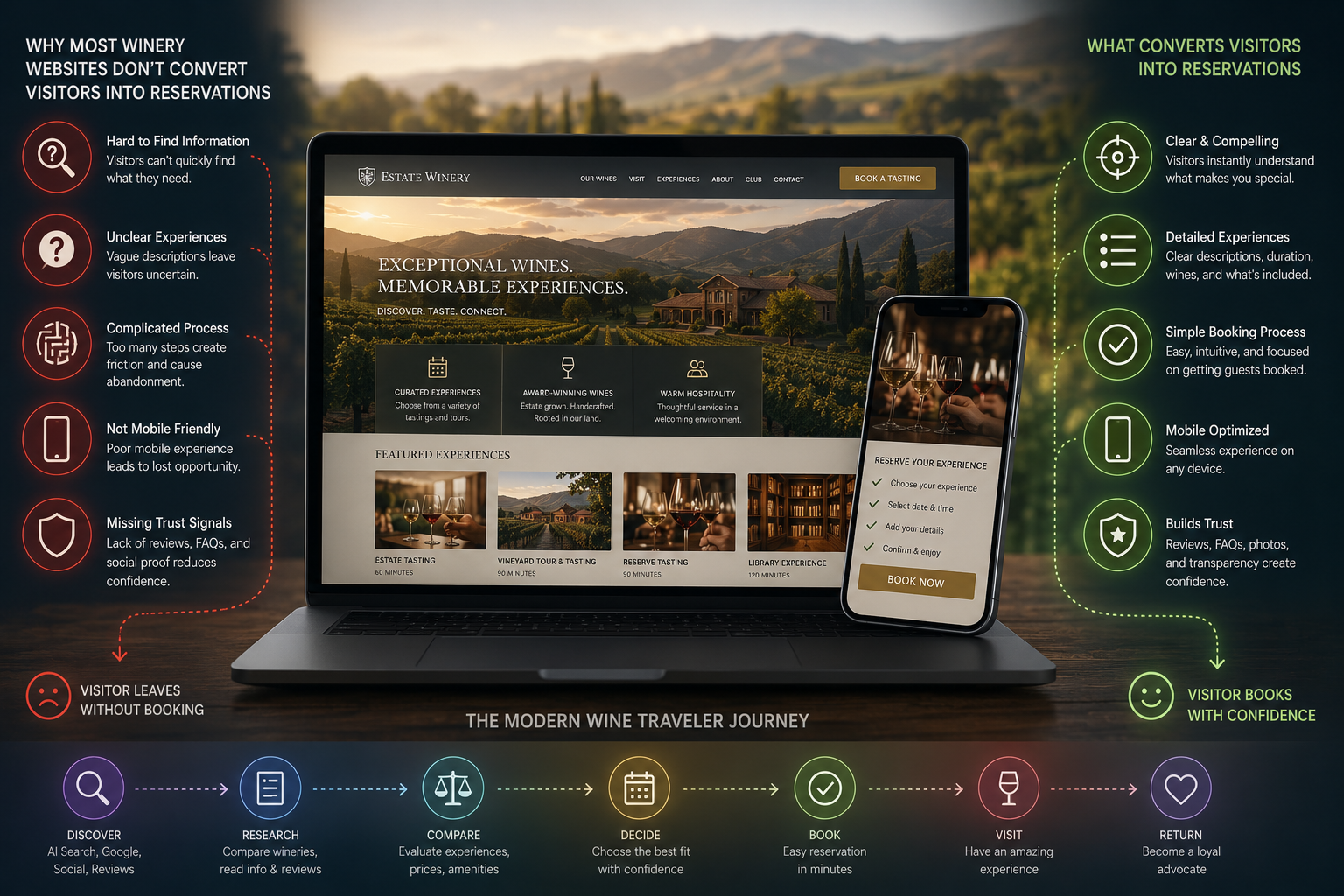
Modern travelers research extensively before making decisions.
They compare:
The more complete your online presence, the easier it becomes for both visitors and AI systems to understand what makes your winery unique.
Search is evolving from:
"Find websites."
to
"Recommend the best place."
Consumers increasingly trust AI to narrow hundreds of options into a handful of personalized recommendations.
If your website doesn't provide the information AI needs, another winery will.
The businesses that invest today in rich, structured, accurate, and helpful content will become tomorrow's recommendations.
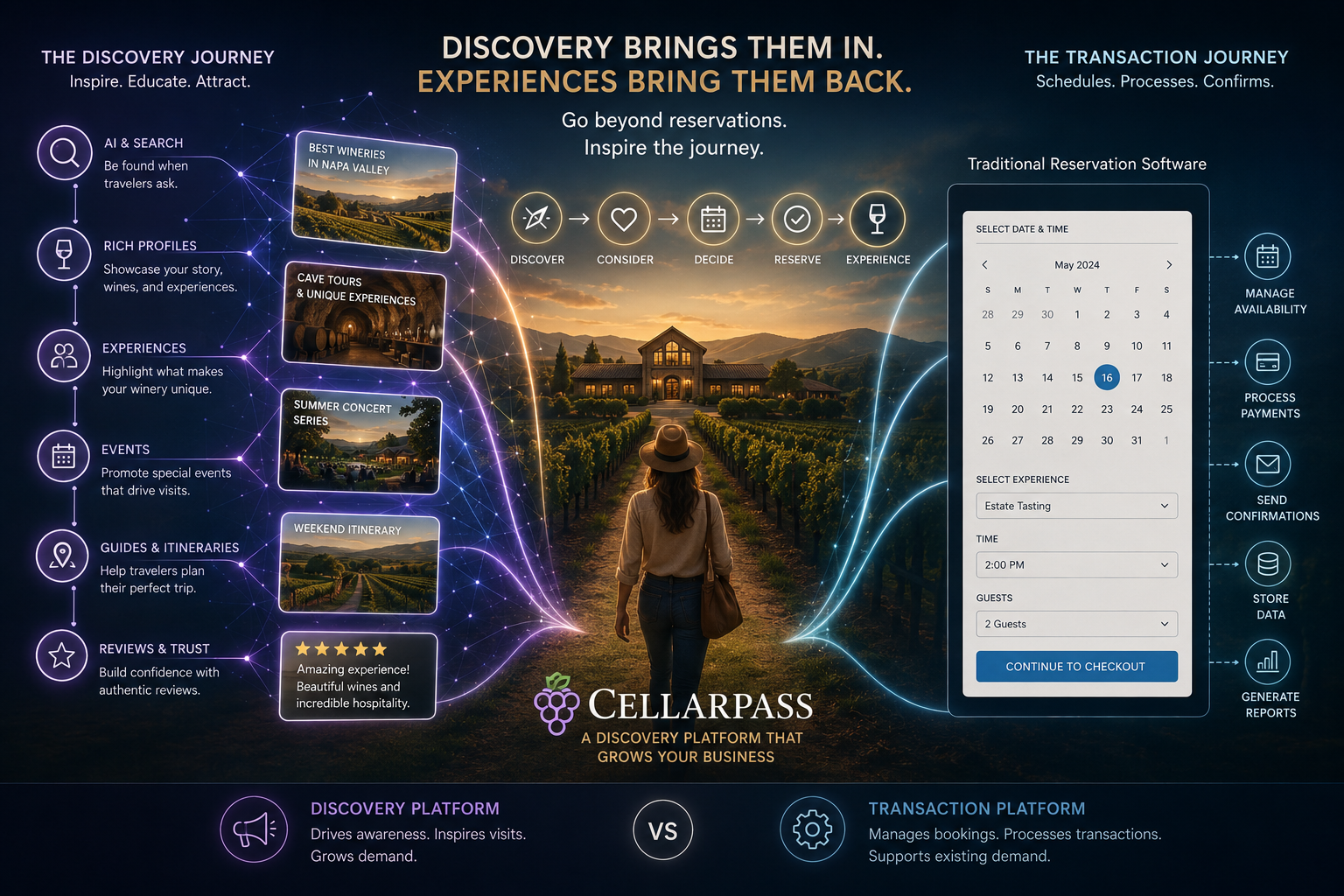
At CellarPass, we're continually evolving our partner platform to support modern search and discovery.
Our partner business pages are designed to showcase the information today's travelers—and tomorrow's AI assistants—look for, including:
By combining traditional SEO best practices with emerging AEO and GEO strategies, partners can build a stronger online presence that serves both human visitors and AI-powered discovery platforms.
SEO isn't going away—but it's no longer enough on its own.
The most successful wineries will embrace a broader strategy that combines:
As travelers rely more on AI to plan their experiences, the quality, depth, and structure of your website content will become one of your most valuable marketing assets.
The wineries that educate, inform, and answer questions today will be the ones recommended tomorrow.