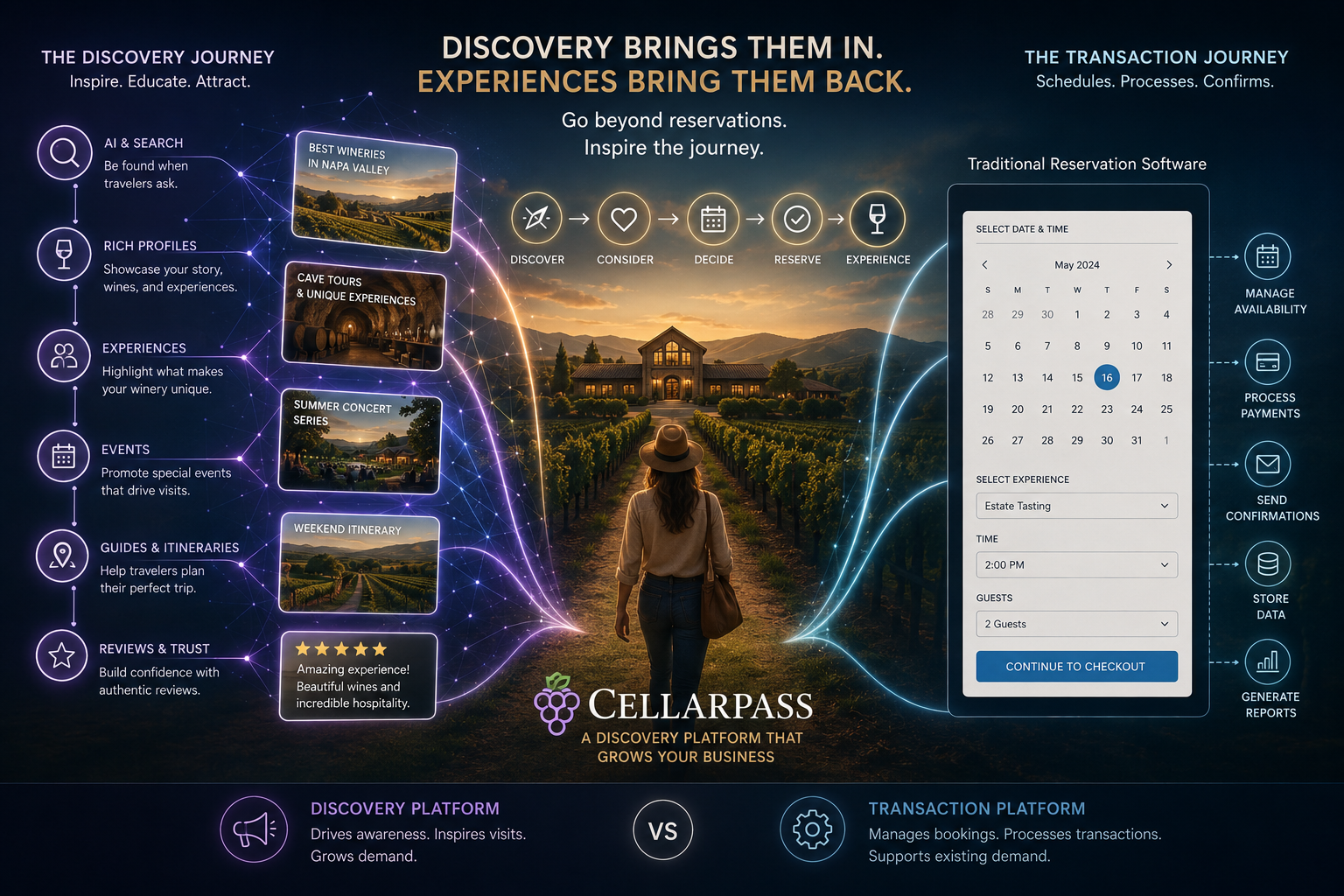
CellarPass drives more guests, revenue, and personalized experiences—fixing OrderPort’s key limitations.

Reservations are a winery’s first impression for many visitors. While platforms like OrderPort provide a centralized, all-in-one solution, guests often encounter friction that impacts their experience—and ultimately, your tasting room revenue. Based on consistent feedback from wine travelers, here are the top complaints guests make when booking through OrderPort Reservations—and why wineries are increasingly seeing the value in CellarPass.
Guests often report that the OrderPort reservation flow feels more like an online purchase than a personal hospitality experience, making wine tasting feel transactional rather than welcoming.
Why it matters: Wine tourists expect warmth and a human touch from the moment they book.
Visitors sometimes struggle to navigate OrderPort’s interface—especially on mobile or when a winery’s webstore isn’t intuitively structured.
Why it matters: If guests cannot quickly find availability or understand options, they’re more likely to abandon the booking entirely.
While OrderPort supports online and phone bookings, guests often feel restricted when trying to adjust reservations last-minute or plan spontaneous visits.
Why it matters: Wine tourism thrives on flexibility and spontaneous decision-making.
OrderPort provides zero direct guest support, and technical support wait times can be days, leaving both guests and tasting rooms frustrated.
Why it matters: With CellarPass, our team intercepts and assists both guests and admins in real time, ensuring questions are answered promptly, bookings are secured, and the guest experience remains seamless. High-touch support like this increases confirmed bookings and reduces no-shows.
OrderPort’s all-in-one platform continues to experience uptime issues, where the system may be unavailable or credit card processing fails. When this happens, it’s not just your eCommerce that’s affected—your POS and all DTC transactions are also down, meaning you can’t take orders, sell tickets, or even process reservations.
Why it matters: By using separate systems for reservations and eCommerce, like pairing CellarPass with your POS, you eliminate a single point of failure. Even if one system experiences downtime, you can still service guests, book reservations, and sell tickets, keeping revenue flowing and your tasting room operating smoothly.
Guests sometimes encounter reserved spots showing as available—or open slots appearing full—when syncing across POS, inventory, and reservation modules fails.
Why it matters: Misleading availability erodes trust and can increase cancellations or no-shows.
Even when reservations can be adjusted, OrderPort’s processes are often confusing, unclear, or tied to rigid eCommerce and club rules.
Why it matters: Transparent and easy-to-understand cancellation policies increase guest confidence to book early.
OrderPort often presents a generic checkout flow, leaving guests feeling like they’re completing a transaction rather than booking a curated tasting experience.
Why it matters: With CellarPass, when a club member enters their email during booking, the system instantly recognizes them and thanks them for being a member. This small, personal touch makes the guest feel valued at the moment of booking, building excitement, loyalty, and a stronger connection before they even arrive. Personalized messaging and branding set the tone for an exceptional experience.
Even if a guest is a club member, perks and pricing are not always applied consistently in OrderPort.
Why it matters: Guests expect loyalty benefits to be seamless and automatic.
Confirmation emails and reminders often come from generic automated templates rather than the winery itself.
Why it matters: With CellarPass, you can place a personal message when booking a guest or create a custom message for each experience. This allows wineries to personalize communication, convey a brand voice, and create anticipation for the visit—enhancing the guest experience from the very first interaction.
OrderPort doesn’t provide a centralized view for guests where they can see all their reservations and ticket purchases across multiple wineries. Guests who forget which winery they booked with often have no easy way to track their plans.
Why it matters: You’ll be surprised how often this feature prevents confusion, improves the guest experience, and reduces last-minute cancellations. CellarPass gives guests a single dashboard for all their bookings and tickets—making it effortless to manage plans and return for additional visits.
There’s a reason wineries consider using built-in systems—they promise convenience—but these platforms can have major impacts on your bottom line beyond the monthly subscription cost.
With CellarPass, the average referral rate is 45% of guests coming directly to tasting rooms, representing revenue that built-in systems simply don’t generate. At that point, an all-in-one platform is just a transaction utility—but wineries need more than transactions. They need more guests, buying wine, and visiting more often.
CellarPass marketing actively showcases tasting experiences and special events, sparking demand for reservations or ticket purchases.
For a single generic winery using CellarPass in 2025:
This estimate is conservative, reflecting only reservation-based visitation—not including club enrollments, repeat visits, ticketing, or wine purchases.
This demonstrates that CellarPass provides a reliable, year-long acquisition channel delivering meaningful incremental revenue while reducing reliance on direct demand alone.
CellarPass is not just a booking engine—it provides marketplace visibility, SEO authority, and ongoing marketing that introduces net-new guests at no additional cost beyond the subscription.
After implementing our experience structure and content recommendations, conversion rates and booking volume improved measurably. These insights, based on aggregated marketplace behavior, are unique to CellarPass and increasingly valuable as booking behaviors evolve.
Choosing a reservations platform is more than just managing bookings—it’s about building your guest base, increasing revenue, and creating memorable experiences.
CellarPass gives wineries the tools to:
For wineries ready to grow, CellarPass is not just a system—it’s a partner in building demand, filling your tasting room, and creating unforgettable guest experiences.
The choice is clear: give your guests the experience they deserve, and let CellarPass deliver measurable results for your winery.